What is a relay?
Relay is electrically operated switch that activates with electric magnet pulling a group of contacts either to form or break the circuit. Relays are generally used for signals, radio frequencies, controlling high voltage circuits at a lower voltage and for loads as resistive motors, lights, inductive and capacitive applications. This is particularly useful when the switch or circuit is not able to handle the required current, for example programmable logic's output cannot control an AC-motor.
Relay features:
- operating/load circuit's galvanic separation
- One output can control multiple outputs
- Separating different load circuits
- Separating AC and DC circuits
- Connection in between electronic circuits and virta circuits
- Multiple connection functions - time delay, signal's state etc.
- Works as an amplifier
TE Connectivity's broad relay range covers automotive relays, plug-in relays, power relays, reed relays, time delay relays, signal relays , general purpose relays and SSR Solid State Relays. TE's relays are typically used for electrical insulation, adjusting current on production and logistics applications as well as connecting smaller current flow values in operating circuit for example in building automation and control panels.
How do relays work?
The principle of operation of the relays is the same regardless of whether they are electromechanical relays, electronic relays, designed to switch a signal or high power loads. Relays convert the primary electrical input signal to control the secondary-side contacts a switching element to connect / control the desired load, for example current. The relays provide a galvanic isolation between the input and output circuits and one relay can control several loads at the same time. Relays can also perform logic functions, such as locking the output on and off from the momentary input.
The following appellations for electromagnetic relays are common:
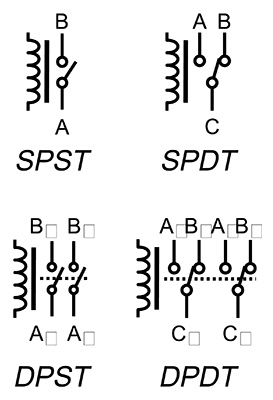
SPST (Single Pole Single Throw)
SPDT (Single Pole Double Throw)
DPST (Double Pole Single Throw)
DPDT (Double Pole Double Throw)
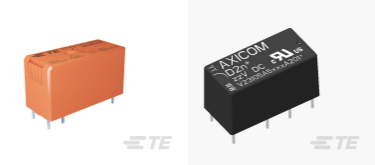
Signal relays and power relays
Signal relays connect signal and current up to 2 amperes (resistive load). Typical applications are measurement systems, computer interfaces and networking devices. Signal relay types include also reed relays and solid state relays. Power relays can connect up to 600 volts and 100 amperes. These relays can switch on a high current which has been usually managed with contactors.
Electromagnetic relays and electronic relays
An electromagnetic relay may be classified by primary intermediate signal and a coupling element between them. The magnetic field generated by the input signal acts on the mechanical contacts. Examples are a standard yoke-type relay and a reed relay. The Yoke Relay consists of a copper coil wrapped around a soft iron core, an anchor, and one or more sets of contacts. The wire winding generates an electromagnetic field when current is applied, which causes the anchor to activate. An anchor is a movable part of a relay that is hinged to a connection and mechanically connected to movable contacts, which opens and closes the contacts and has a spring that returns it to its original position. The anchor stays in place with the spring, so when the relay is turned off, an air gap is left in the magnetic circuit. All versions offer the same basic operating concept, but electrical relays are available in different sizes and types using slightly different technology.
Electronic relays use electronic switches - such as transistors, triacs (semiconductor components) - as the main switching element. This allows the relay to control a much larger circuit. Other types of electronic relays that transmit by other means, such as optically, frequency modulation, or capacitive effects, are optoisolators. On the primary side, the optical signal is transmitted by a light emitting diode, while the phototransistor acts as a receiver and controls the switching element. Thermoelectric relays primary input energy to heat the bi-metal part, which uses contacts mechanically.
General features:
| Features | EMR | SSR |
| Sensitivity to abuse | Good | Bad |
| Sensitivity to corrosion, oxidation or contamination | Yes | No |
| Sensitivity to impact, vibration or acceleration | Yes | No |
| Sensitivity to radiation | Satisfactory | Bad |
| Product versatility | Good | Satisfactory |
| price per connection | Excellent | Satisfactory |
| Input TTL & CMOS (buffer) compatibility | Satisfactory | Excellent |
| Usage ja release time | 5-20 mS | 25-10 mS |
| Suitability for Military requirements | Good | Bad |
| Ease of troubleshooting | Good | Bad |
| Input and output insulation ability | 4Kv | >4Kv |
| Normal fault condition (output) | Open | Short circuit |
| Normal wear mechanism | Contacts | LED |
Electromechanical relays are sensitive to high accelerations. The relays must not be dropped, thrown, because the arm where the contact surface makes up most of the weight may, when dropped, twist the contact arm of the relay and break the relay.
See the table below for a more detailed comparison.
Contact types
Most of the relays work as a Non-Latching principal which means a relay keeps its chosen position by consuming energy when primary side coil has a current. Latching (Impulse) relay changes its position when it is directed to control's primary side. This feature is becoming valuable in the future as in alternative energies a continuous production of energy is not possible and/or lower energy consumption is wanted. Latching relay does not consume energy when it is on, while a normal relay would, although not necessarily that much.
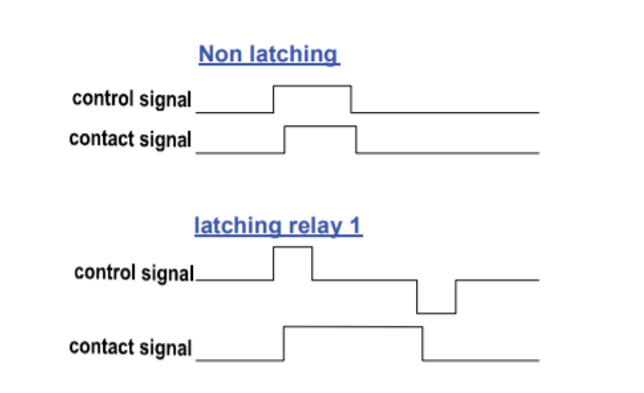
Relay's contacts are either NO (Normally Open) or NC (Normally Closed) depending on is the relay active or not. CO, Change Over contains both functions.
Contact materials and plastics used in relays
Relay's contact resistance increases over time the more it is used and contact tips are stained by the electric arcs. This is why relay's contacts are plated with different silver-based mixtures in order to greatly increase their life span. Electromagnetic relays' contacts are treated with the following mixtures:
- Ag-Cu - silver-copper
- Ag-CdO - silver-cadmium oxide
- Ag-W - silver-tungsten
- Ag-Ni - silver-nickel
- Ag-Pd - silver-palladium
Note that cadmium as a contact material is not recommended anymore and is not available in general for new products, but is widely used in old production series.
In relay cases, glow wire (GW), hot wire test is a feature which is required in increasing quantities on new applications.