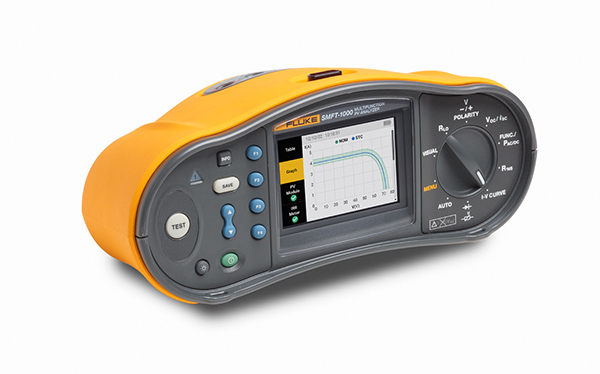
Solar panels - Measurement and installation
Solar panels are becoming more popular and sunny days are ahead. What should be taken into consideration to maximize energy yield and avoid installation errors? In this topic, we will focus on these questions by going through what one should take into account when measuring and installing solar panels. The Fluke IRR1-SOL solar irradiance meter will be used as an example for measurements.
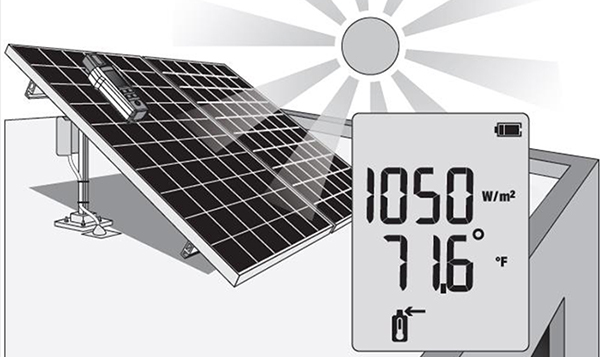
Measuring radiation and temperature
Begin by placing the meter face up on the panel so that the temperature probe on the device can measure the temperature of the panel at the same time. Wait for the temperature reading to stop flashing, at which point it will have reached an accurate temperature reading.
The rated output of a solar panel or the number of watts per peak (Wp) does not tell you what happens outside standard conditions. Conditions as when the temperature falls below or exceeds +25 degrees Celsius or when the amount of radiation applied to the panel is more or less than 1000 W/m2.
+25 degree panels produce about 16-18 % of the sun's radiation. If the panels become warmer, the yield decreases by 0.4 % for each risen degree. Some solar panels have experienced problems with so-called thermal cut-off, where the output of the solar panels has collapsed in summer time when the roof temperature got too hot.
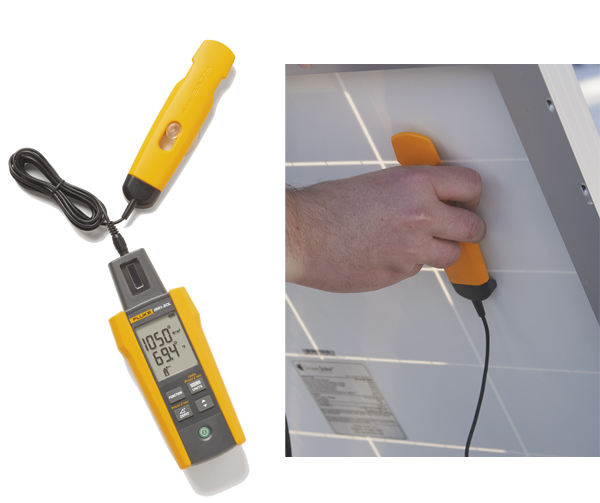
Temperature measurements with an external probe
Measuring the backside temperature of the panel is an important step. An external sensor, supplied with the device, can be attached to the backside of the panel with a suction cup. The amount of radiation can be measured at the same time.
For solar panels to work well, it is important to ensure that there is sufficient cooling space underneath them. In general, the minimum space should be 10 cm, as less space will lead to an uncontrolled increase in the surface temperature of the solar panels, which in turn will reduce yield, accelerate the ageing of the solar panels, increase the risk of hotspot and even fire. In addition, the warranty on solar panels will not be valid if the cooling space does not meet these requirements.
Quote from Motiva's website:
”The backside of solar panels should be ventilated. This is done by leaving a gap between the panels and the structures behind them to let the air flow freely. An unventilated structure will increase the temperature of the panels, which will lead to a significant drop in the efficiency of the panels, especially of crystalline silicon. During peak production periods in spring and summer, the temperature of the panels without backside ventilation rises tens of degrees above ambient temperature, which reduces yield significantly. The problem is less severe for thin-film panels, as their efficiency is not as dependent on ambient air temperature as that of crystalline silicon panels.”
Shading on the panels
One has to take shadows in to account when installing solar panels, which might appear on the surface of the panels. Shadows cast by tall buildings or trees take up part of the yield and cause grey hairs afterwards.
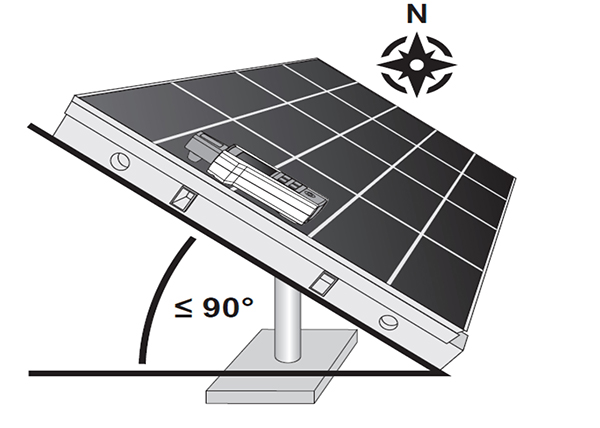
Panel tilt angle and orientation
Most efficient tilt angle is about 35-45 degrees. Deviating from optimum angle will reduce annual production slowly. 30 and 60 degree tilt angles are almost as efficient to produce energy as optimum angle. 15 degree deviation from optimum angle decreases annual yield by about 5%.
Small tilt angle is most efficient in mid-summer but at a more vertical angle, the panels produce steadily from spring to autumn, but then fall short of peak production in mid-summer.
Solar trackers are available for panels that can at best double annual production. However, they increase the purchase price and incur higher repair costs than fixed panels. However, in Finland, high levels of scattered radiation (40-50%) can make solar tracking unprofitable.
Perform the compass measurement away from the PV panel by holding the irradiance meter or by placing it on a horizontal plane (0-20 degrees tilt angle) with the tip of the meter pointing towards the PV panel. To ensure a reliable compass reading, the instrument should be kept away from metal objects, as they interfere with the operation of the compass.
Click the link below to see the solar irradiance meter talked about in the article.